
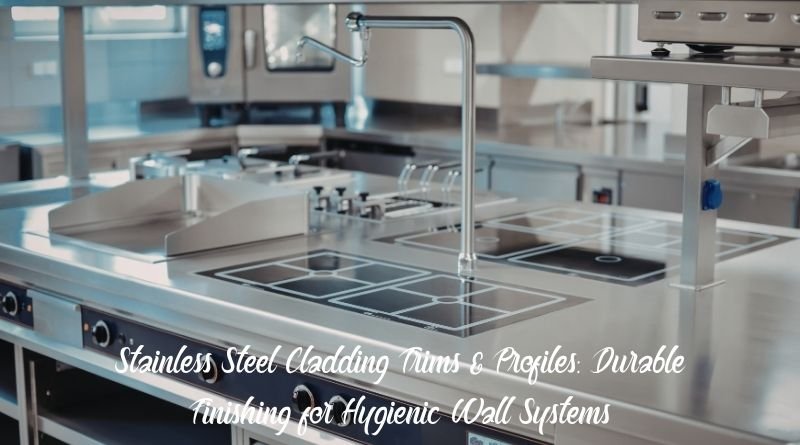
Stainless steel cladding trims and profiles are essential finishing components used to complete stainless steel wall cladding installations. Designed to join panels, protect edges, and create clean transitions, these profiles provide both structural support and a professional hygienic finish.
Widely used in commercial kitchens, healthcare facilities, food production environments, and industrial spaces, stainless steel trims offer superior durability and corrosion resistance compared to standard plastic alternatives.
What Are Stainless Steel Cladding Trims & Profiles?
Stainless steel trims and profiles are precision-formed metal sections manufactured from stainless steel, typically in grades such as 304 or 430. They are designed to work alongside stainless steel wall cladding sheets and hygienic wall systems to create sealed, durable installations.
These profiles are available in a variety of shapes and sizes to suit different applications. Common profile types include internal corners, external corners, joining trims, edge trims, and capping sections.
Their smooth metallic finish complements stainless steel wall panels, creating a coordinated and professional appearance while supporting hygiene and long-term durability.
Key Benefits of Stainless Steel Profiles
One of the main advantages of stainless steel cladding trims is their exceptional durability. Stainless steel is highly resistant to impact, wear, heat, and corrosion, making these profiles ideal for demanding commercial and industrial environments.
Hygiene is another major benefit. The smooth, non-porous surface is easy to clean and prevents the absorption of moisture, grease, and bacteria, supporting strict hygiene standards.
Corrosion resistance is particularly important in areas exposed to moisture, cleaning chemicals, or temperature fluctuations. Stainless steel profiles are designed to withstand these conditions while maintaining their appearance and structural integrity.
In addition, stainless steel trims provide a premium and professional finish that enhances the appearance of the entire cladding system.
Common Types of Stainless Steel Trims
There are several types of stainless steel trims and profiles used in wall cladding installations. Internal corner profiles are designed to create smooth transitions where two walls meet, while external corner trims protect exposed edges from impact and damage.
H-section joining trims are commonly used to connect two wall panels together neatly on larger installations. J-section trims and edge profiles are used to finish exposed panel edges and create clean borders.
Capping trims and cover profiles may also be used to conceal fixings and provide additional protection around panel edges or openings.
Each profile type is designed to work with specific panel thicknesses and installation requirements.
Applications Across Different Environments
Stainless steel cladding trims and profiles are widely used in commercial kitchens, where hygienic and heat-resistant wall systems are essential. They help create sealed, easy-to-clean surfaces that comply with food safety standards.
Healthcare environments benefit from stainless steel profiles because they support infection control by eliminating gaps and creating smooth, disinfectable surfaces.
Food processing facilities use these trims in conjunction with stainless steel wall panels to maintain hygiene compliance and withstand frequent cleaning.
Industrial and warehouse environments also use stainless steel profiles for their durability and resistance to wear in high-traffic or heavy-use areas.
Installation and System Integration
Installing stainless steel trims and profiles requires careful measurement and accurate fitting to ensure a professional result. Profiles are cut to size and fixed using suitable adhesives, screws, or mechanical fixings depending on the application.
Wall panels are then installed alongside or within the profiles, creating a fully integrated and sealed system. Silicone sealants may also be applied where necessary to create watertight joints and improve hygiene performance.
Because stainless steel is more rigid than PVC, precise installation is important to achieve proper alignment and a clean finish.
Maintenance and Long-Term Performance
Maintenance of stainless steel cladding trims is straightforward. Regular cleaning with suitable stainless steel cleaning products helps maintain both hygiene and appearance.
Their resistance to corrosion, staining, and impact ensures they continue to perform effectively over time, even in demanding environments with regular cleaning and heavy use.
By protecting panel edges and joins, stainless steel profiles also help extend the lifespan of the overall cladding system.
A Premium Finishing Solution for Hygienic Environments
Stainless steel cladding trims and profiles provide the strength, hygiene, and professional finish required for modern wall cladding systems. Their ability to withstand demanding conditions while maintaining a clean and polished appearance makes them an ideal choice for commercial and industrial environments.
Whether used in kitchens, healthcare settings, or industrial facilities, stainless steel finishing profiles help create durable, hygienic installations built for long-term performance.